

The 10 Best Dog Breeds to Adopt for Families (2026)
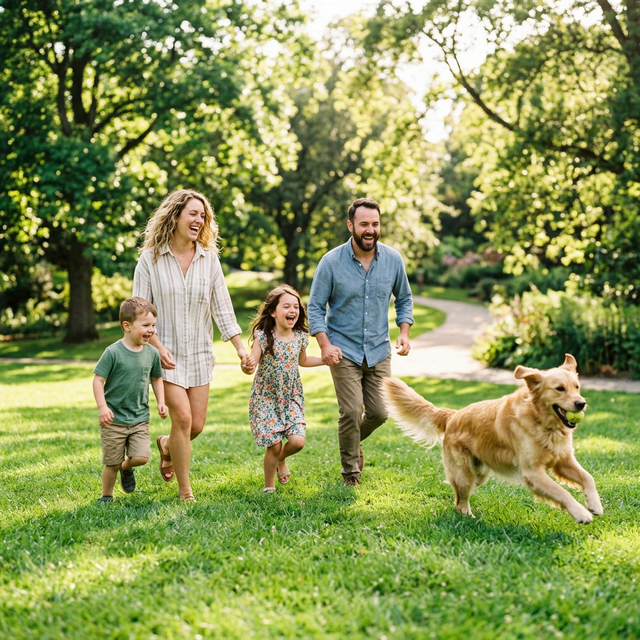
Choosing the right dog breed for your family is a crucial decision that should not be taken lightly. A dog will be with you for 10 to 15 years, it will be part of your holidays, your weekends and your daily life. You might as well make sure that its temperament matches your lifestyle!
While the dog’s appearance plays a role, it is its character, energy level and tolerance to noise (inevitable with children!) that should guide your choice. Here is our detailed selection of the 10 best breeds (and crossbreeds) for family adoption in 2026.
🥇 1. Golden Retriever — The Undisputed King of the Family
The Golden Retriever is consistently at the top of family rankings worldwide, and for good reason: it is pure concentrated love.
- Temperament: Extremely gentle, patient, intelligent, and always eager to please its master.
- With children: Excellent. It is naturally protective, tolerant of little ones’ clumsiness, and does not have an ounce of aggression.
- Exercise: Active (1-2 hours of walking per day). It loves to fetch objects and swim.
- Size and weight: 51-61 cm for 25 to 34 kg. It’s a large size that takes up space!
- Health: Watch out for hip dysplasia and heart problems (typical of large dogs). Life expectancy: 10-12 years.
Did you know? The Golden Retriever is the no. 1 assistance and therapy (animal mediation) dog in France thanks to its supernatural empathy towards humans.
🥈 2. Labrador Retriever — The Eternal Big Kid
Often confused with the Golden (although short-haired), the Labrador is the most popular family dog in the world.
- Temperament: Extremely sociable, joyful, energetic, and very (very) greedy.
- With children: Perfect. It loves playing for hours and being cuddled endlessly.
- Exercise: High (1-2h/day). A bored Labrador can become destructive at home.
- Attention: Its legendary greed strongly predisposes it to obesity. You must strictly ration its food and monitor its weight.
🥉 3. The “Mutt” or Shelter Crossbreed — The Choice of the Heart
Often forgotten in breed rankings, the crossbred dog (often affectionately called a “mutt” or “mongrel”) is statistically the best family dog you could adopt.
- Temperament: Unique! By adopting an adult crossbreed from a shelter, you immediately know its definitive character as evaluated by the volunteers.
- With children: Shelters test the sociability of dogs (understanding with children/other dogs/cats) before adoption, which secures your choice.
- Health (Hybrid Vigour): This is the great advantage of crossbreeds! Thanks to genetic mixing, they suffer much less from hereditary diseases linked to the inbreeding of pure breeds (dysplasia, ocular defects, etc.).
- Life expectancy: Often longer than a purebred dog of the same size (12-15 years).
4. Cavalier King Charles Spaniel — The Little Prince of Sofas
The Cavalier King Charles is ideal for families who want an extremely affectionate dog, devoid of aggression, but without the imposing size of a large dog.
- Temperament: Very calm, gentle, and fusional (even a little dependent) with its master.
- With children: Very good, it is patient and tolerant, but its small size requires children to be respectful so as not to hurt it.
- Exercise: Moderate (30-45min/day).
- Ideal for: Apartment living and rather homebody families.
- Attention (Health): The breed is unfortunately very prone to heart disease (MVD) and neurological diseases (syringomyelia). Significant veterinary costs are often to be expected from the age of 6/7.
5. Australian Shepherd — The Tireless Family Athlete
The Australian Shepherd has become the favourite dog of the French, but beware, it’s not a dog for everyone! It is the perfect choice only for very sporty families.
- Temperament: Extremely intelligent, dynamic, loyal, very close to its family (“velcro” dog).
- With children: Very protective. Its herding dog instincts may lead it to want to “gather” children by nipping at their calves.
- Exercise: Very high (2h+ of intense activity per day). It has a vital NEED to run and exert itself mentally (agility, tracking, obedience).
- Attention: An under-stimulated “Aussie” will inevitably develop major behavioural problems (compulsive barking, destruction, hyperactivity). It is not suitable for sedentary families or those absent 10h a day.
6. Beagle — The Joyful Companion with a Super-Powered Nose
The Beagle is a medium-sized hound with a jovial character and an irresistible face.
- Temperament: Joyful, playful, very curious, extremely sociable with humans and other dogs.
- With children: Excellent playmate, tireless.
- Exercise: Moderate to high (at least 1h per day).
- Training and attention: It’s a hunting dog driven by its nose. When it catches an interesting scent, it tends to ‘disconnect’ and become deaf to your calls. It has a reputation for being a bit stubborn and needs a well-fenced garden because it’s the king of escaping.
7. French Bulldog — The Charming City Dweller
The French Bulldog has conquered the hearts of urban families all over the world thanks to its atypical appearance (bat ears) and adaptability.
- Temperament: Very affectionate, mischievous (the real clown of the house), brave.
- Exercise: Low to moderate (30-45min of quiet walking per day).
- Ideal for: Apartments, the city, and families who do little intense physical exercise.
- Health (Crucial point): It is a brachycephalic breed (flat face). They are extremely sensitive to heat (risk of fatal heatstroke in summer), snore a lot, and often suffer from severe respiratory, digestive and back problems. Favour adopting adult bulldogs in shelters to relieve those who have been abandoned because of the heavy veterinary costs they generate.
8. Border Collie — The Hyperactive Genius
The Border Collie is scientifically considered the smartest dog in the world, capable of learning hundreds of words.
- Temperament: Brilliant, hard-working, ultra-energetic, sensitive.
- Exercise and stimulation: Very, very high. This is not a couch potato dog. It needs running, but above all daily intellectual fatigue (obedience tricks, object searching, herding).
- Ideal for: Families in the countryside, very sporty, ready to invest in advanced positive reinforcement training.
9. English Cocker Spaniel — The Gentle Dreamer
The Cocker is a medium-sized dog with an irresistible drooping gaze and long golden ears.
- Temperament: Joyful, enthusiastic at work, loyal, sometimes a little exclusive with one family member.
- Exercise: Moderate (1h/day), it loves snooping in the undergrowth during walks in the forest.
- With children: Very good, patient and playful, provided it has been well socialised and the children respect its space (no pulling ears!).
- Maintenance: Its long coat requires regular grooming and almost daily brushing to avoid matting, as well as frequent cleaning of the ears (prone to ear infections).
10. German Shepherd — The Majestic Great Protector
The German Shepherd is the ultimate versatile guard and working dog, but also an incredible family companion.
- Temperament: Extremely loyal, brave, very intelligent, suspicious of strangers but totally devoted to its family group.
- With children: Very protective, extremely gentle with “its” children (a little less so with the neighbours’ ones if it feels they are playing too roughly with yours).
- Exercise: High (1h30 to 2h/day minimum).
- Ideal for: Houses with fenced land (ideally) and assertive owners who know the principles of positive dog training. A poorly trained or rarely walked German Shepherd can become difficult to manage given its power.
How to Choose the Right Breed for YOUR Family?
Don’t base it on a whim after seeing a cute video on TikTok. Sit down as a family to answer honestly to these 5 questions:
- Living space: Cramped apartment in the city center (exit large alert dogs that bark) or large isolated house with 2000sqm of fenced land?
- REAL available time: Do you really have 1 to 2 hours every day (even in winter in the rain or when sick) to take it out and make it run?
- The family budget: Are you ready for the annual cost of a dog which fluctuates between €800 and €1200 in 2026 (not counting serious medical emergencies)? Feeding a 35 kg Golden costs triple what it costs to feed a 7 kg Jack Russell.
- Age of the children: Do you have babies or teenagers? A puppy requires as much training time as a newborn.
- Your canine experience: Is this your first dog (Novice) or do you have experience in dog training? (Avoid Malinois or Akita Inu for a first dog).
Responsible Adoption: The Winning Choice for Families
If you are looking for a purebred dog (or perfect crossbreed), seriously consider adoption in a shelter or through an association rather than buying from a breeder. Every month, Labradors, Australian Shepherds and adorable crossbreeds are abandoned (divorces, moves, death of the owner).
By adopting:
- You save a life (and free up a spot for a stray dog).
- You precisely know the adult dog’s character (ideal with children!).
- You pay much less (€150-300 in adoption fees vs €1000-2500 for a purchase).
- The animal is already house-trained, microchipped, vaccinated and often neutered.
Find your ideal family companion among more than 4,000 verified ads. Download the Adopt’Animaux app and use our local filters — it’s 100% free!